Table Of Contents
- What Payment Rails Are
- The Main Payment Options for Global Businesses
- How to Compare Payment Rails
- Where Real-Time Payments Fit
- When Local Rails Make Sense
- The Role of Stablecoin Settlement
- Risk, Compliance, and Payment Controls
- A Step-By-Step Selection Process
- Common Mistakes to Avoid
- Final Takeaway
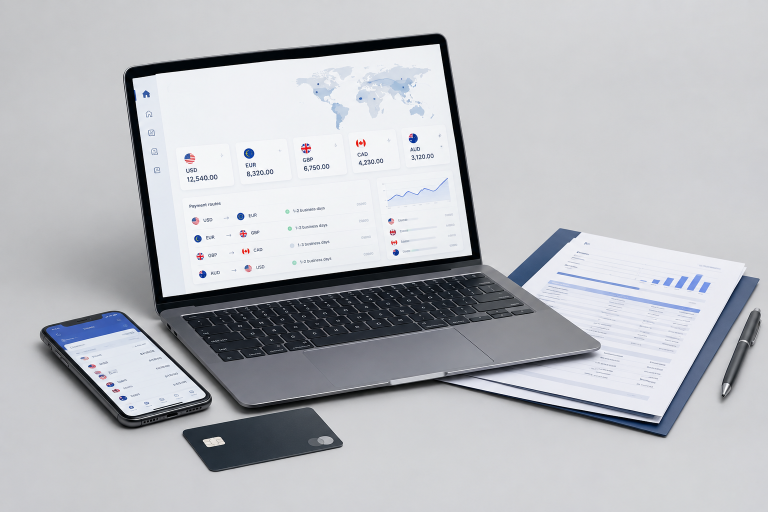
Moving money across borders is no longer a one-size-fits-all banking task. Businesses can combine bank wires, domestic payment networks, cards, and digital settlement tools based on where they pay, how quickly funds must arrive, and how much control the finance team needs. A well-designed international business account can help centralize these decisions while giving teams a clearer view of balances, currencies, and outgoing payments.
The right rail is rarely simply the fastest or cheapest option. It is the route that reliably delivers usable funds to the intended recipient, produces the records required for reconciliation, and aligns with the company’s compliance process. A practical payment strategy starts by understanding what each rail does well and where it introduces friction.
What Payment Rails Are
A payment rail is the underlying network or system used to move funds between two parties. It is different from a payment method, such as a bank transfer or card, and different from the provider that gives a business access to that method. One international payment may use more than one rail before it reaches the beneficiary.
The route can change based on the sending and receiving currencies, destination country, payment value, timing, recipient account type, and required checks. That is why two payments that appear similar on an invoice can have very different delivery times and total costs.
The Main Payment Options for Global Businesses
Traditional Bank Transfers
International bank transfers remain important for high-value supplier payments, treasury movements, and destinations with limited alternatives. Many cross-border transfers rely on correspondent banking relationships, where banks work through one another to complete a payment in another market or currency.
The main advantages are a broad geographic reach and familiarity for business recipients. However, intermediary charges, bank cut-off times, additional review steps, and incomplete payment-status information can make the final cost and delivery window difficult to predict.
Local Bank Rails
Local rails are domestic payment systems used within a country or region. Examples include ACH in the United States, SEPA transfers in Europe, Faster Payments in the United Kingdom, and Pix in Brazil. When a business can pay a local account in the recipient’s preferred currency, the transaction may involve fewer handoffs than a conventional international wire.
These rails can be useful for recurring contractor payments, supplier invoices, marketplace payouts, and regional payroll. Access may depend on having local account details, local-currency funds, or a banking partner that supports the destination rail.
Card-Based Business Payments
Cards are often practical for travel, software subscriptions, online services, and smaller operational purchases. They can offer acceptance controls, transaction alerts, and dispute processes. They are usually less suitable for large invoices or routine treasury transfers because suppliers may not accept cards or may pass processing costs to the buyer.
Stablecoin Settlement
Stablecoins are digital tokens designed to maintain a stable reference value, often linked to a national currency. They can support transfers outside traditional banking hours, but they also require a compliant process for custody, wallet verification, conversion, recordkeeping, and local withdrawal. They are an additional settlement option, not an automatic replacement for bank-based payments.
How to Compare Payment Rails
Before choosing a route, compare options using the complete payment outcome rather than the advertised sending fee alone:
- Speed: When will the recipient have usable funds, not merely a payment confirmation?
- Total cost: Include transfer fees, foreign-exchange spreads, intermediary deductions, receiving fees, and internal processing time.
- Coverage: Confirm the destination country, currency, recipient type, and transaction size are supported.
- Reliability: Determine what happens when a payment fails, is returned, or requires more information.
- Data quality: Check whether references, status updates, and reports allow the finance team to match payments to invoices.
- Compliance: Verify that screening, verification, approvals, and records fit the business’s obligations.
Where Real-Time Payments Fit
Real-time payment systems are designed to process eligible transactions continuously, rather than only during standard banking hours. In the United States, the FedNow Service supports instant payment services through participating financial institutions, with funds made available to recipients immediately.
Domestic instant payment capability does not automatically create an international payment network. A cross-border payment may still require currency conversion, access to a local account, recipient verification, and compliance review. Businesses should maintain a fallback route for unsupported corridors, rejected payments, and exceptions that need manual attention.
When Local Rails Make Sense
Local rails are often most compelling when a business makes frequent payments in the same market. They can improve the recipient experience because suppliers and contractors receive funds through a familiar domestic method. They may also reduce the number of intermediaries involved in delivery.
Still, local payment systems have limits. Transaction caps, operating rules, account-format requirements, currency restrictions, and availability through a provider can all affect whether a rail is appropriate for a specific payment.
The Role of Stablecoin Settlement
For businesses evaluating stablecoin settlement, the operational details matter as much as transfer speed. Teams should establish rules for approved networks, verified wallet addresses, custody arrangements, conversion providers, liquidity needs, accounting treatment, and transaction monitoring. A wallet-address error can be costly because completed blockchain transfers may not be easily reversible.
Compare stablecoins with local bank rails based on the actual corridor. If the recipient needs local currency in a bank account, the quality and cost of the off-ramp may matter more than the speed of the on-chain transfer.
Risk, Compliance, and Payment Controls
Faster payments require stronger payment controls because there may be little time to stop a transaction once it is released. Core safeguards should include:
- Know-your-customer and business-verification procedures.
- Sanctions and restricted-party screening.
- Beneficiary verification before a new payment is approved.
- Approval thresholds based on payment value and risk.
- Fraud alerts for unusual beneficiaries, locations, amounts, or timing.
- Records connecting the payment to its invoice, purpose, and source of funds.
A Step-By-Step Selection Process
- List major payment corridors, currencies, recipient types, and typical amounts.
- Separate urgent payments from routine invoices and scheduled payouts.
- Measure the full cost for each route, including foreign exchange and staff effort.
- Confirm rail availability for each corridor and business use case.
- Choose at least one backup route for critical payments.
- Test reconciliation, references, settlement reports, and exception handling.
- Run a small pilot before expanding to additional markets.
- Review delivery times, failed payments, costs, support needs, and compliance holds regularly.
Common Mistakes to Avoid
- Selecting a rail solely because it advertises a low transfer fee.
- Ignoring the foreign-exchange spread and receiving-side charges.
- Assuming instant processing always means immediate access to spendable funds.
- Using a method that the recipient cannot access or does not trust.
- Skipping beneficiary confirmation for new or changed bank details.
- Delaying reconciliation until the end of the month.
- Using digital assets without documented compliance and accounting procedures.
- Depending on a single bank, provider, or payment route.
Final Takeaway
The best payment rail depends on the corridor, currency, value, urgency, recipient preference, and risk profile. Strong global payment operations usually combine multiple options rather than forcing every transaction through a single channel. The goal is to deliver funds on time, control total costs, support compliance, and provide the finance team with a reliable record of every payment.